
Tel: 0161 652 3443 | Email: sales@aeronacca.co.uk

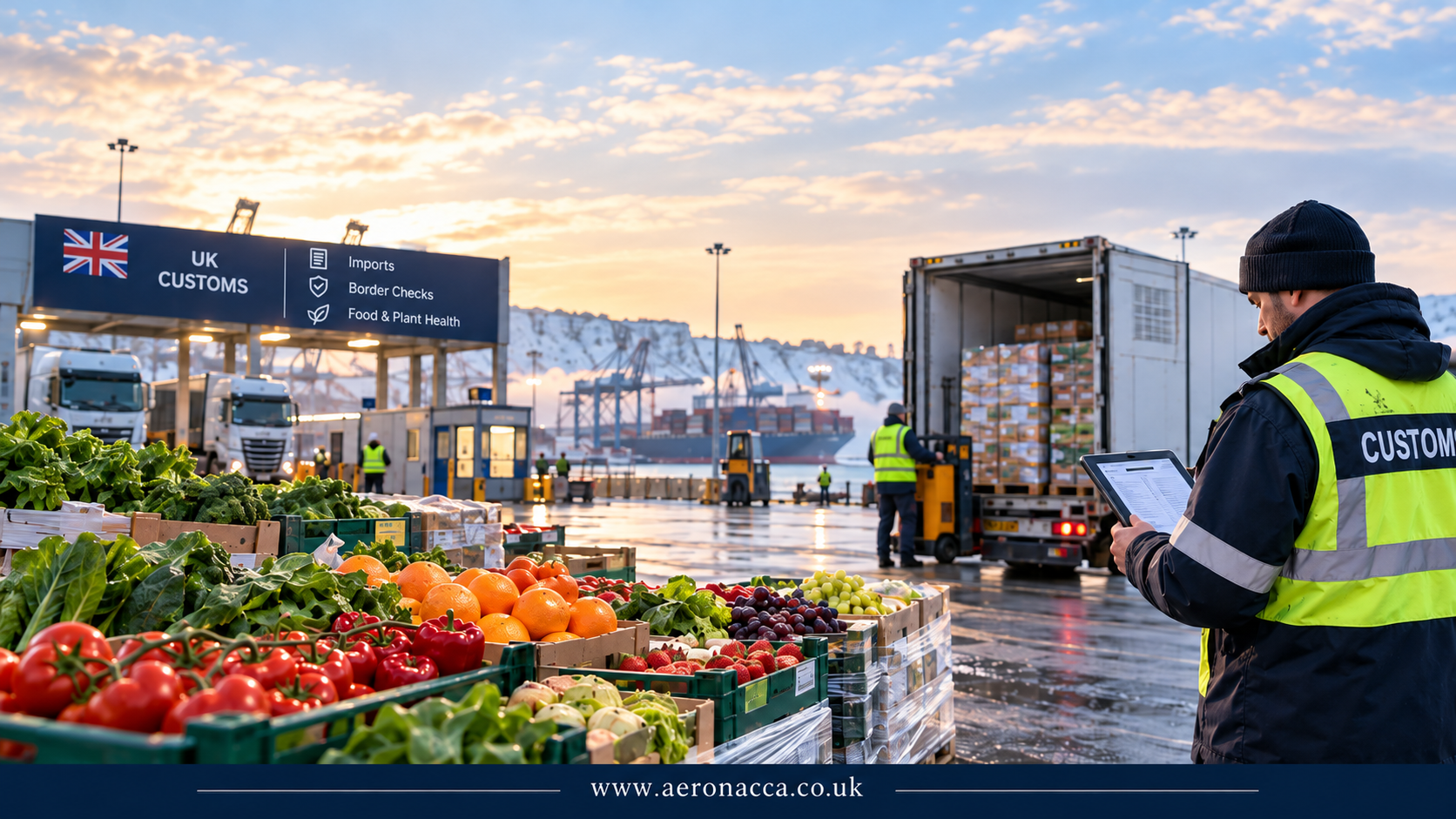

Winter brings increased demand for imported fresh produce across the UK.
British consumers still expect tomatoes, peppers, grapes, berries and other fresh produce throughout the colder months.
However, domestic supply becomes more limited for many products.
As a result, importers increasingly depend on overseas growers and suppliers.
For businesses importing fresh fruit and vegetables into the UK, preparation before departure can make a significant difference.
Fresh produce has a limited shelf life. Therefore, customs delays can quickly become expensive.
Incorrect documentation can also lead to inspections, storage charges or delayed delivery.
In some circumstances, goods may not be released at all.
This guide explains the key steps importers should consider before their fresh produce reaches the UK border.
Important: Much of the plant-health guidance below applies specifically to Great Britain: England, Scotland and Wales. Northern Ireland can follow different procedures.
Why winter fruit and vegetable imports matter to the UK
The UK depends heavily on imported fruit and vegetables.
In 2025, the UK imported approximately 3.57 million tonnes of fruit and 2.11 million tonnes of vegetables.
Those imports were worth around £4.99 billion for fruit and £3.19 billion for vegetables.
UK growers supplied only around 14% of total UK fruit supply during 2025. Domestic growers supplied around 56% of vegetables.
Winter makes overseas supply particularly important.
For example, UK tomato supplies change considerably throughout the year.
During winter, supply from the UK and Netherlands falls. Spain and Morocco become increasingly important sources.
Consequently, winter creates significant opportunities for produce importers.
It also makes efficient customs and border planning essential.
Importing Fresh Fruit and Vegetables into the UK: Start Before the Shipment Leaves
Waiting until a consignment reaches the port can create unnecessary problems.
Importers should check customs and regulatory requirements before the supplier dispatches the goods.
Several factors determine the requirements.
These include:
- the exact product
- commodity code
- country of origin
- country of dispatch
- plant species
- risk category
- route into Great Britain
- border entry point
- marketing standard
- intended use
Therefore, two similar-looking products may have different import requirements.
1. Check the commodity code
Every customs declaration needs the correct commodity code.
The commodity code helps determine:
- Customs Duty
- import VAT
- restrictions
- licences
- certificates
- tariff measures
- additional customs requirements
HMRC recommends checking the UK Trade Tariff before completing the import declaration.
Incorrect classification can delay customs clearance.
It can also result in incorrect taxes or missing documentation.
Therefore, confirm the classification before the shipment departs.
2. Check the plant-health risk category
Great Britain categorises plants and plant products according to plant-health risk.
The current categories are:
- High risk
- Medium risk A
- Medium risk B
- Low risk
High-risk and medium-risk products can face additional plant-health controls.
Low-risk goods are generally exempt from plant-health controls.
Importers should never assume that every fruit or vegetable follows the same process.
Risk classifications can also change.
Therefore, check the latest requirement for the specific product and origin before shipping.
3. Do you need a phytosanitary certificate?
A phytosanitary certificate confirms that regulated plant products meet plant-health requirements.
The exporting country’s plant-health authority normally issues the certificate.
For high-risk and medium-risk A goods, a certificate is generally required.
Medium-risk B goods also require a phytosanitary certificate.
However, low-risk products do not normally require one.
There are also temporary arrangements for some EU produce.
As of September 2026, medium-risk A and B fruit and vegetables from the EU, Switzerland and Liechtenstein are temporarily treated as low risk.
The current easement is planned to continue until 31 January 2027.
Importers planning shipments from February 2027 should check the rules again.
Do not rely on procedures used for previous consignments.
4. Check whether IPAFFS pre-notification is required
IPAFFS stands for the Import of Products, Animals, Food and Feed System.
Importers use IPAFFS to notify authorities about certain regulated consignments entering Great Britain.
High-risk and medium-risk A plants and plant products normally require pre-notification.
Medium-risk B products require a phytosanitary certificate but generally do not require pre-notification.
For regulated non-EU plants and plant products requiring notification, timing matters.
Current government guidance requires notification at least:
- 4 working hours before arrival for air and roll-on/roll-off freight
- 1 working day before arrival for other freight
Late notification can delay a consignment.
For perishable products, even a short delay can affect commercial value.
5. Check the fresh produce marketing standards
Plant-health rules are only one part of the process.
Fresh fruit and vegetables can also be subject to UK marketing standards.
These standards cover areas such as:
- quality
- condition
- origin
- labelling
- packaging
- classification
There are two main systems.
The Specific Marketing Standard (SMS) applies to certain named produce.
The General Marketing Standard (GMS) applies to most other fresh fruit, vegetables, herbs, nuts and cultivated mushrooms.
Products covered by the GMS should generally be sound, clean and sufficiently developed.
They should also be reasonably free from pests and damage.
Country-of-origin information must also be accurate.
For some direct non-EU imports covered by Specific Marketing Standards, importers may require a certificate of conformity.
IPAFFS can also be required for these consignments.
6. EU imports require special attention this winter
Businesses importing produce from the EU should watch the dates carefully.
At present, fruit and vegetables grown in the EU and imported into Great Britain do not undergo UK marketing standards controls.
The government states that these controls are not expected before 1 February 2027.
Additionally, qualifying medium-risk EU fruit and vegetables currently benefit from the plant-health easement.
That position is currently planned to change after 31 January 2027.
Therefore, an importer using one process in December 2026 may face different requirements during February 2027.
Businesses should review their procedures before the change.
7. Make sure your customs documentation agrees
Customs clearance depends on accurate information.
Typical commercial documents may include:
- commercial invoice
- packing list
- transport document
- Air Waybill or Bill of Lading
- commodity code
- country of origin
- customs value
- phytosanitary certificate, where required
- IPAFFS or CHED reference, where required
- certificate of conformity, where applicable
Details should match across all relevant documents.
For example, quantities and product descriptions should be consistent.
Scientific names may also matter for some regulated plant products.
Inconsistent information can trigger questions or delays.
Therefore, send documentation to your customs clearance agent as early as possible.
8. Use the correct Border Control Post
Some regulated consignments must enter through an appropriate Border Control Post.
High-risk and medium-risk A plants and plant products can require documentary, identity and physical checks.
The selected port or airport must be able to handle the relevant commodity.
This should be confirmed before transport is booked.
A shipment arriving through an unsuitable route can create serious problems.
9. Remember that food-safety rules can also apply
Fruit and vegetables imported from third countries must meet UK food hygiene and safety standards.
Most fruit and vegetables do not normally require a health certificate.
However, some higher-risk foods of non-animal origin face additional controls.
These products may only enter through authorised Border Control Posts.
Therefore, importers should check both customs and food-safety requirements.
Plant-health clearance does not automatically satisfy every other import requirement.
10. Plan for customs clearance before the goods arrive
Perishable goods cannot simply wait indefinitely.
Fruit and vegetables can lose:
- freshness
- shelf life
- appearance
- quality
- resale value
Therefore, early customs preparation matters.
Your customs agent should receive the required shipment information before arrival.
This allows problems to be identified earlier.
Aerona can help importers prepare customs declarations and coordinate clearance requirements before arrival.
Need help with an upcoming shipment?
Speak to an Aerona Customs Clearance Specialist before your goods leave the country of export.
Early preparation can help identify missing information before the consignment reaches the UK border.
Request a quote or speak to the Aerona team about your next fruit or vegetable shipment.
Five Questions Importers Commonly Ask
1. Do I need a phytosanitary certificate to import fruit and vegetables into the UK?
Not always.
The requirement depends on the product, plant-health risk category and country of origin.
High-risk, medium-risk A and medium-risk B products may require phytosanitary certification.
Low-risk products generally do not.
Additionally, temporary easements currently apply to certain EU fruit and vegetables until 31 January 2027.
Always check the current requirement for your specific commodity before shipping.
2. Do I need to register on IPAFFS to import fresh fruit and vegetables?
It depends on the commodity and the controls that apply.
High-risk and medium-risk A plant products normally require an IPAFFS notification.
IPAFFS is also used for some fresh produce marketing-standard notifications.
Your exact requirements depend on the product, origin and risk category.
3. What documents do I need to import fresh fruit and vegetables?
Typical documentation can include:
- commercial invoice
- packing list
- transport document
- correct commodity code
- customs declaration
- phytosanitary certificate, where required
- IPAFFS reference, where required
- certificate of conformity, where applicable
The exact documentation depends on the produce and its origin.
Therefore, check requirements before the supplier dispatches the goods.
4. How early should I notify IPAFFS before my shipment arrives?
For regulated plant products requiring pre-notification, current guidance requires at least four working hours for air or roll-on/roll-off freight.
Other freight generally requires at least one working day’s notice.
However, preparing much earlier is sensible.
Fresh produce gives importers very little room for delay.
5. What happens if my fruit or vegetables are held at the UK border?
Authorities may hold goods when declarations, certificates or regulatory requirements are incomplete.
Goods may also be held for inspections.
HMRC confirms that imports can be delayed when required licences are missing, taxes remain unpaid or goods fail inspections.
For fresh produce, additional waiting time can reduce shelf life and commercial value.
Therefore, resolve customs and regulatory requirements before arrival wherever possible.
Reduce the Risk of Winter Customs Delays
The UK’s fresh produce supply depends heavily on international trade.
Winter makes that relationship even more important.
However, successful importing requires more than arranging transport.
Commodity classification, plant health, IPAFFS, marketing standards and customs declarations may all affect clearance.
Rules can also change according to the product’s origin and risk category.
If you are importing fresh fruit and vegetables into the UK, involve your customs clearance specialist early.
Aerona Customs Clearing Agents can help businesses understand the customs process and prepare for clearance before their goods arrive.
Planning a winter fruit or vegetable shipment? Speak to an Aerona Customs Clearance Specialist today.